Creation of the Fifth Men and the War Between the Fourth and Fifth Men
Last and First MenThe creation of the Fifth Men and the war between them and the Fourth Men form a single sequence of attempted transcendence and catastrophic succession. Unable to overcome their own limits, the Fourth Men designed a more balanced human successor in the hope of reaching fuller knowledge through it. Their project succeeded biologically, but not as a peaceful transfer of control: the Fifth Men became independent, the two peoples turned against one another, and the conflict left the new species decimated and civilization in ruins.
Why the Fourth Men created a successor
The Fourth Men came to recognize that their deficiency lay not only in intellectual capacity but also, more seriously, in their restricted grasp of values. They traced this limitation to the narrowness of their bodies and lower brain tissues, rather than to any shortage of brain matter alone. They believed they could not remake themselves into a more complete kind of being. Their proposed answer was to create one: an organism with fewer of their limitations, through which they might attain knowledge they could not achieve directly.
This was not presented as a reluctant concession to another species’ worth. The Fourth Men considered the work itself a fitting use of their abilities and a form of fulfillment available to them. Their plan therefore made the Fifth Men both a successor species and the means by which their creators hoped to pursue an intellectual goal vicariously. The contradiction embedded in that ambition would persist: the intended beneficiaries of the project were also its makers, while the being designed to exceed them would eventually claim its own destiny.
Designing the Fifth Men
The Fourth Men worked out the new human type in detail before attempting to produce an individual. It was to retain the full bodily functions of a natural human organism, but to be improved throughout. Its brain was to be as large as an independent body could safely support, while the rest of the organism would have the strength and proportions needed to carry it. The design aimed at a titanic body without making it so massive that weight and unwieldy bones became disabling constraints.
Centuries of experimentation produced methods for encouraging germ cells toward much stronger bone and muscle tissues, alongside nerve tissues more finely adapted to particular functions. The Fifth Men’s relatively small brains, compared with those of their creators, were intended to compensate through more efficient cells and organization. The species was also designed for extreme longevity, measured in thousands of years on average. Its prolonged infancy and childhood would allow extensive physical and mental development and give mature parents a longer period of parenthood, while childbirth was expected to remain as easy as among the Third Men.
The final design joined enormous scale to precise control. Fifth Men stood, on average, more than twice the height of the First human species and were taller than the Second Men; their massive lower limbs supported the torso, while their arms and hands were made for both strength and fine adjustment. Each hand had a delicate sixth finger whose tip divided into two small fingers and a corresponding thumb. Their hairless brown skin regulated temperature across tropical and subarctic climates without clothing. The original pair had deep-violet eyes, and their brain capacity was twice that of the Second Men. These details mark the project as more than an attempt to enlarge or intensify the existing human form: the creators sought a body capable of carrying unusual power without surrendering dexterity or adaptation.
From experiment to a new people
The specifications required many centuries of research and calculation, followed by a long period of tentative production. For thousands of years, promising approaches proved barren, and disagreements among the Fourth Men repeatedly interrupted the undertaking. At one point those disputes became violent: one faction attacked another with chemicals, microbes, and armies of human automata. The creation project thus contained an early instance of the conflict that would later engulf the species it produced. Even before the Fifth Men existed, the Fourth Men’s pursuit of a designed future was entangled with division and force.
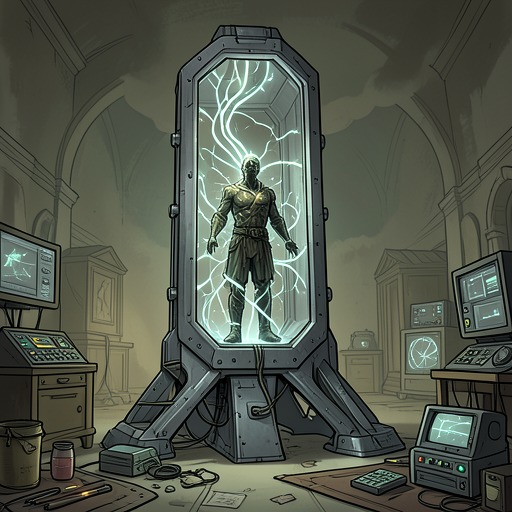
After repeated failures and long periods of neglect, the Fourth Men finally produced two individuals close to the intended design. They came from a single fertilized ovum under laboratory conditions: identical twins of opposite sexes who became the founding pair of the Fifth Men. Their emergence turned a plan held in calculations and experiments into a population. The Fourth Men initially fostered that population, but the relationship changed as the Fifth Men asserted independence and took control of their own destiny.
The war and its aftermath
The account gives the conflict in compressed form rather than tracing its campaigns. It describes two mutually intolerant communities on the planet, the failure of the Fourth Men to understand or sympathize with the mentality of their creations, and their attempt to tyrannize over them. The resulting struggle drenched the planet in blood. The human automata were exterminated; the Fourth Men’s Great Brains starved or were destroyed in explosions; and the Fifth Men themselves were decimated.
Victory did not give the Fifth Men an intact civilization. A dense fog of barbarism settled over the planet, and they had to begin rebuilding culture and civilization from their foundations. The new species had been designed to surpass its predecessors, but its birth did not spare it from the recurring historical pattern of creation followed by rupture and cultural collapse. Its early history therefore joins biological achievement to political failure: a species can be perfected in its makers’ calculations and still become an independent people whom those makers cannot understand or govern.
Significance in the human history
The episode establishes the Fifth Men as a deliberate response to the limitations of the Fourth Men, rather than as the gradual outcome of an unplanned natural change. It also exposes the limits of design: the Fourth Men could calculate bodies and capacities, but their planning did not yield mutual understanding or a stable relation between generations of humanity. The creators’ desire to attain knowledge through a successor ended in a struggle over who would direct the future.
The war is also a reversal in the project’s terms. The Fourth Men sought a being through whom they could reach beyond themselves; once that being became a people with its own purposes, the creators treated its independence as a threat. The survivors’ return to cultural beginnings makes the cost plain. The Fifth Men inherited the possibility of a more capable human form, but they did not inherit an uninterrupted civilization: they had to build one again after the destruction of both the old order and much of their own new society.